
Flowers are complicated and so are people.
According to St. Thérèse, rosiness does not devalue lily-ness, and both the lily and the rose–all flowers, in fact–are equal in dignity. In her analogy of flowers to people, it’s easiest to assume that Thérèse is comparing one kind of perfection to a different kind of perfection. How flattering it would be if this were true. Simple as The Little Flower is, she does not sugarcoat reality for simplicity’s sake.
As we should strive to do with all quotes, let us interpret Thérèse’s analogy in its full context:
“I wondered for a long time why God has preferences, why all souls don’t receive an equal amount of graces. I was surprised when I saw Him shower His extraordinary favors on saints who had offended Him, for instance, St. Paul and St. Augustine, and whom He forced, so to speak, to accept His graces. When reading the lives of the saints, I was puzzled at seeing how Our Lord was pleased to caress certain ones from the cradle to the grave, allowing no obstacle in their way when coming to Him, helping them with such favors that they were unable to soil the immaculate beauty of their baptismal robe. I wondered why poor savages died in great numbers without even having heard the name of God pronounced.
Jesus deigned to teach me this mystery. He set before me the book of nature; I understood how all the flowers He has created are beautiful, how the splendor of the rose and the whiteness of the Lily do not take away the perfume of the little violet or the delightful simplicity of the daisy. I understood that if all flowers wanted to be roses, nature would lose her springtime beauty, and the fields would no longer be decked out with little wild flowers.
And so it is in the world of souls, Jesus’ garden. He willed to create great souls comparable to Lilies and roses, but He has created smaller ones and these must be content to be daisies or violets destined to give joy to God’s glances when He looks down at His feet. Perfection consists in doing His will, in being what He wills us to be.“
Excerpt from Story of a Soul, Chapter 1
I acknowledge the danger involved in interpreting this oft-misinterpreted quote and have committed myself to courting that danger anyway. The quote is comparable to St. Catherine of Siena’s beloved “Be who you were meant to be and you will set the world on fire” (I’d hate for that one to be misinterpreted) or St. John Paul II’s short-but-sweet “Be not afraid” in that many Catholics know the quote, but not where it comes from.
The Little Flower’s quote originates from curiosity about the different ways in which God reveals Himself and offers His graces, and blossoms (the pun was bound to appear) into a commentary on our relationships to one another.
Step 1: The Gardener plants different flowers. Step 2: The flowers complement one another through their differences. If those differences did not exist, neither, I daresay, would the perception of beauty–or if it did, it would be awfully limited.
Thérèse completes her analogy with an observation about perfection. It is attainable, and so is the knowledge of how to attain it. She offers the same advice as her fellow female Doctor of the Church: be who God intended you to be.
Flowers aren’t perfect and neither are people.
Not always.
We can lose our perfection as easily as we can attain it, just like salvation.
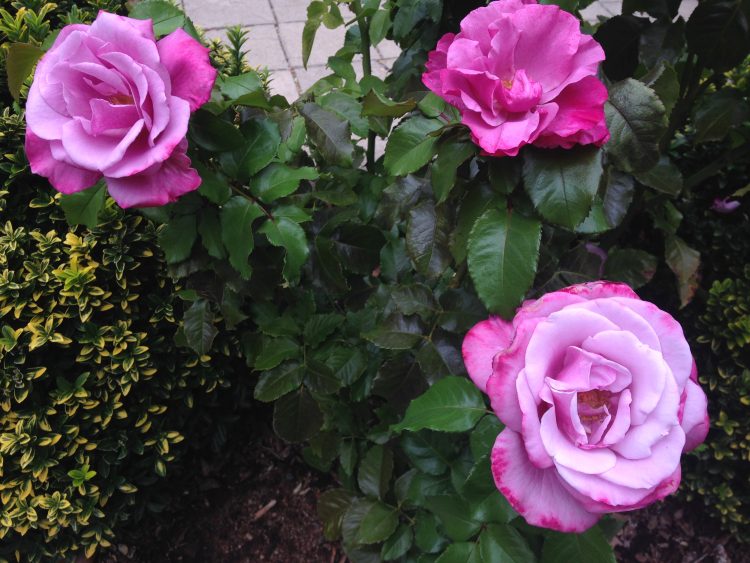
The roses pictured in the photo above seem perfect at first glance, and perhaps they are, but by comparing them, as humans naturally do in their fallen state, we tend to twist differences into imperfections, observations into criticisms.
The rose in the top left is not as full as the one in the bottom right. The one in the bottom right is not as bright as the one in the top right. The one in the top right is more wilted than the other two. How equally beautiful they must be in the Gardener’s eyes, yet how easy it is for one rose to complain to another, “Your brightness takes away from my fullness,” or worse, for one rose to boast to another, “My vitality dominates your frailty.”
And we haven’t even introduced other types of flowers into the photo!
People are imperfect, and Thérèse does not pretend otherwise. However, they can become perfect, and, I would add, are better disposed to becoming perfect with the help of their loved ones who are planted nearby.
My family is about as diverse as they come. One of the most perplexing realities for my parents is how they managed to raise three young women consistently and similarly, in the same household, with a mere year and a handful of months between births, yet their daughters’ personalities could not be more different. (Nevertheless, we all have our Faith in common, and that is the greatest miracle of all.)
As much as I strive to be like Thérèse, I will probably never be as “little” as her, or at least will not possess the same manner of littleness. My sisters and mother are much “smaller” than me. This is to be considered a compliment to them. I’m an overconfident blogger who supposes every thought she has is Gospel, meanwhile, my sister Jessica is the gentle, quiet force behind Stop to Smell the Flowers who suggested I write a blog in the first place…so you may direct all complaints about this website to her.
It seems no coincidence, then, that the violet reminds me of my sister Kailey, or that the daisy is my mother’s favorite flower, and that the violet and the daisy are the two flowers Thérèse happens to consider “little” and “simple.”
People, and especially families, are not as perfect as often as they should be, but you can bet that when they are perfect, their perfection is due in some part to their regard of their natural differences as strengths rather than weaknesses.
Flowers are as comparable to men as to women.
I am compelled to make one last comment (in this post, at least) about flowers, and it is in regard to the assumption that they possess a connotation of femininity. Perhaps I should have posted a picture of manly flowers (sorry, but I didn’t have any of those in my photo library) or chosen a blue color for the text of Thérèse’s quote (sorry, but the pink just coordinated better).
It would be fair to say Thérèse believes men fit as appropriately into her flower analogy as women. Undoubtedly, women deserve to receive bouquets from men as a reflection of and a display of reverence for their special dignity (what JPII calls “the feminine genius”), but as far as the Garden of Life is concerned, the rose might not look as lovely if the lily were not planted beside it.
Anyway, have you seen how handsomely that lily lays in St. Joseph’s arms?
 Stop to Smell the Flowers
Your an amazing woman. Hugs
LikeLiked by 1 person
Thank you, Annie!
LikeLike